African Insurance Leaders to Meet in Benin to Drive Insurance Inclusion Across the Continent
Despite representing nearly 19% of the world’s population, Africa accounts for less than 1% of global insurance premiums, highlighting a significant gap in access to financial protection across the continent. In response, African insurance stakeholders are mobilizing to expand insurance coverage and strengthen the sector’s role in economic development.
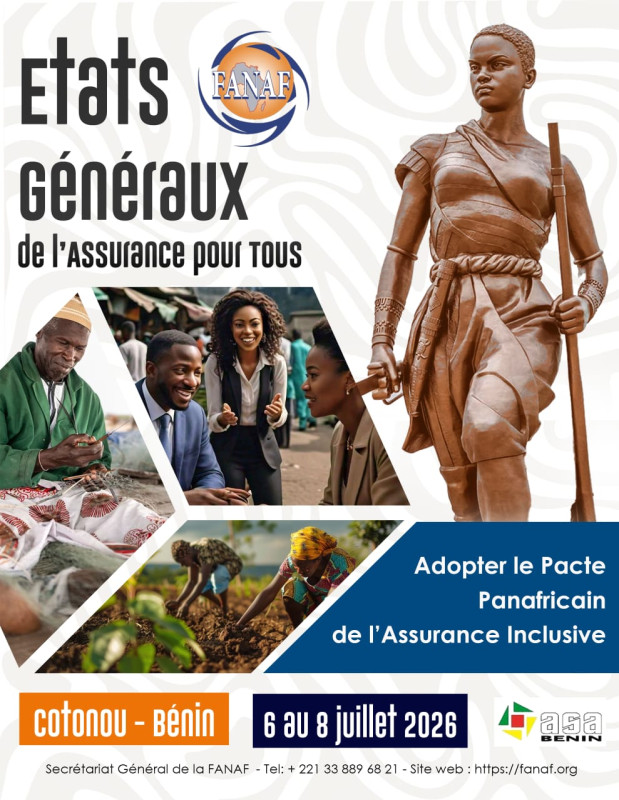
From July 6 to 8, 2026, the Federation of African National Insurance Companies (FANAF) will host its General Assembly on “Insurance for All” at the Sofitel Hotel in Cotonou, Benin. The event will serve as a major pan-African platform dedicated to advancing inclusive insurance solutions.
The assembly is expected to bring together nearly 400 participants, including government officials, regulators, insurance and reinsurance companies, financial institutions, development banks, technical and financial partners, and professional organizations from across Africa.
The goal is to build a common vision and secure concrete commitments that will accelerate insurance access for African populations while increasing the sector’s contribution to the continent’s social and economic development.
A key outcome of the event will be the adoption of the Pan-African Pact for Insurance Inclusion, accompanied by a 2026–2030 Strategic Action Plan. Together, these initiatives aim to coordinate efforts around an ambitious target: doubling insurance penetration across the FANAF region by 2040.
Insurance as a development priority
Insurance penetration in many African countries remains extremely low. Within the CIMA zone, insurance penetration is below 1% of GDP, compared to a global average of more than 6%.
As a result, millions of households, farmers, entrepreneurs, small businesses, and informal sector workers remain vulnerable to health, climate, economic, and social shocks due to limited access to protection mechanisms.
FANAF believes addressing this gap is essential for sustainable development.
According to FANAF President Mamadou Koné, Africa cannot achieve long-term growth without strengthening protection systems for its people, businesses, and investments. He said the Cotonou assembly should mark the beginning of a new continental ambition for the insurance industry and its role in Africa’s economic transformation.
Beyond risk protection
FANAF is seeking to reposition insurance as more than a tool for managing risk. The organization views it as a strategic driver of economic resilience, financial inclusion, savings mobilization, investment security, climate adaptation, and SME financing.
Through the General Assembly, insurance is being presented as a critical pillar of Africa’s broader economic, social, and financial transformation.
A continental action plan
The Pan-African Pact for Insurance Inclusion will serve as a common framework to unite governments, regulators, insurers, financial institutions, and development partners around shared objectives.
Its accompanying 2026–2030 Strategic Action Plan will outline priority actions, coordination mechanisms, and monitoring systems to ensure implementation and accountability.
Public and private sector partners will work together to turn these commitments into measurable outcomes that benefit African economies and communities.
Cotonou as a platform for collaboration
Beyond the insurance industry itself, the General Assembly aims to create a unique platform for dialogue among policymakers, investors, financial institutions, technical partners, and market participants to identify practical solutions for expanding insurance access across Africa.
Hosting the event in Benin reflects the country’s ongoing economic and financial transformation and demonstrates the growing commitment among African stakeholders to develop homegrown solutions tailored to the continent’s realities.
FANAF hopes Cotonou 2026 will become a landmark moment that accelerates insurance inclusion and launches a long-term continental movement to strengthen financial protection for millions of Africans.