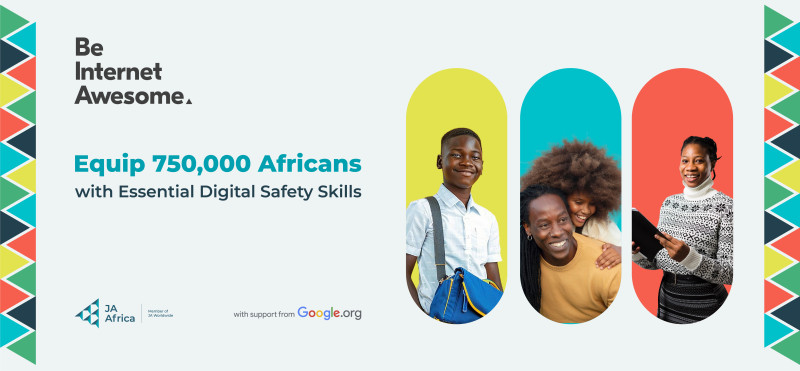
Junior Achievement Africa Partners with Google to Promote Digital Safety for African Youth, Educators, and Parents
Junior Achievement (JA) Africa, with support from Google.org through USD $1.5 million in funding, is set to deliver digital literacy and online safety education to children, teachers, and parents in Ghana, Kenya, Nigeria, and South Africa.
Through this innovative initiative, JA Africa will implement Google’s Be Internet Awesome (BIA) curriculum, equipping 250,000 children aged 7–15, 6,000 teachers, and 8,000 parents and caregivers with the skills and confidence to navigate the digital world safely and responsibly by 2027.
As internet access expands rapidly across Sub-Saharan Africa, many children are coming online for the first time without adequate guidance. Studies indicate that in Nigeria, over 70 percent of children aged 6–12 use the internet but lack basic online safety awareness. Similar trends are seen in Ghana, Kenya, and South Africa, where risks such as cyberbullying, harassment, and exploitation remain prevalent.
“As digital connectivity becomes central to modern life in Africa, it is critical that our children are equipped not only to participate but to be protected,” said Simi Nwogugu, CEO of JA Africa. “With support from Google.org, we are empowering young people to turn access into opportunity, cultivating a generation of smart, safe, and responsible digital citizens.”
Developed by Google, Be Internet Awesome combines interactive lessons with Interland, a gamified online platform that teaches children about privacy, cyberbullying, and media literacy in a fun and engaging way.
“At Google.org, we believe every child should be able to explore the internet with confidence and care,” said Alessia Scarpellini, Senior Program Manager, Child and Youth Safety and Digital Wellbeing, Stronger Communities, Google.org EMEA. “By supporting JA Africa’s community-based approach, we are helping educators, caregivers, and children across the continent build the skills to be safe and confident online.”
The program will be delivered through school workshops, teacher trainings, and community outreach initiatives, ensuring access even in rural and underserved areas. It aligns closely with national child-protection and ICT-in-education frameworks, including Ghana’s National Child Online Protection Framework, Nigeria’s Child Online Protection Policy, and Kenya’s Industry Guidelines for Child Online Protection.
Program Targets by 2027:
- 250,000 children trained in online safety, cyberbullying prevention, privacy, and digital citizenship
- 6,000 teachers certified as facilitators to integrate BIA into classrooms
- 8,000 parents and caregivers engaged through workshops and digital learning modules
- Over 750,000 people reached directly or indirectly across the four countries
The initiative will also be promoted through awareness campaigns, digital storytelling, and flagship events such as Safer Internet Day 2026, reaching millions more across Africa. JA Africa and Google.org will work closely with Ministries of Education, ICT, and Communications to embed the curriculum into school systems and teacher training programs, ensuring long-term sustainability.
“This initiative highlights the power of collaboration in protecting Africa’s future generation,” Nwogugu added. “By uniting governments, educators, families, and the private sector, we can build a safer, more inclusive digital Africa for every child.”