Why Many Africans Are Losing Faith in Justice
A new Afrobarometer Pan-African survey reveals that many Africans continue to depend on both formal and informal justice systems to resolve legal disputes, while widespread doubts persist about whether courts deliver fair, affordable, and timely justice.
The report, based on 50,961 interviews conducted across 38 African countries in 2024/2025, shows that while many citizens would first turn to police or local courts when facing legal problems, a significant share—about one in four—prefer traditional leaders, elders, or customary courts. This reflects the continued coexistence of formal and informal justice systems across the continent.
Overall confidence in formal courts remains limited. Only half of respondents believe that ordinary citizens can obtain justice through the court system. Perceptions of fairness and efficiency are similarly mixed, with just over half believing they could receive a fair outcome, and fewer than half expressing confidence that cases are resolved in a reasonable timeframe.
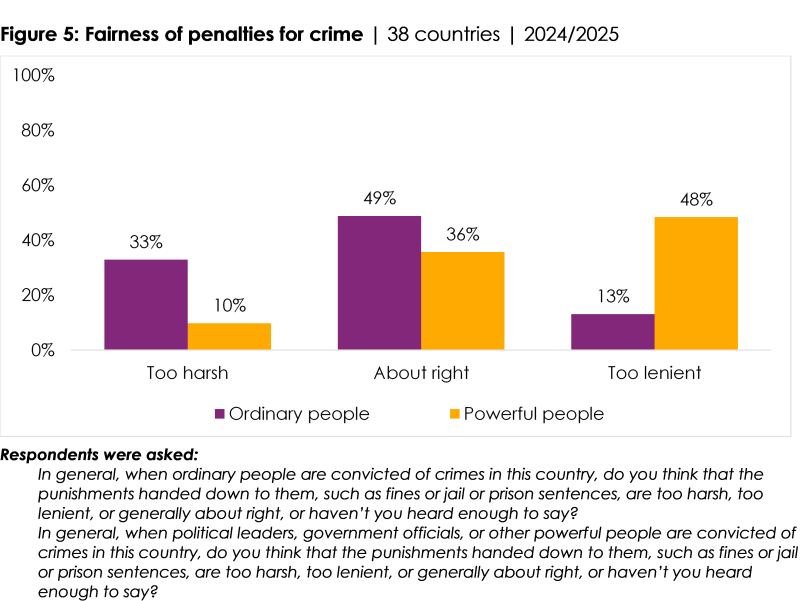
The survey also highlights deep concerns about inequality within justice systems. A majority of respondents say people are often treated unequally under the law, while nearly half believe that powerful individuals who break the law are treated too leniently. By contrast, only a small minority believe ordinary people receive the same leniency.
Access to justice is further constrained by financial barriers. Fewer than half of Africans believe they could afford legal assistance or court-related costs if needed, suggesting that cost remains a major obstacle to using formal legal systems.
Key findings from the report show that reliance on multiple justice systems is widespread, with 41% of respondents saying they would first approach the police and 7% local courts, while 26% would go to traditional authorities. Trust in fairness stands at about 50%, while perceptions of timely case resolution are lower at 43%.
On inequality, 59% of respondents believe people are often or always treated unequally under the law. In addition, 48% say powerful individuals tend to get off too lightly when they break the law.
Afrobarometer notes that these findings come from its Round 10 surveys conducted between 2024 and 2025. The pan-African, nonpartisan research network conducts nationally representative face-to-face interviews across participating countries, providing insights into citizens’ experiences of governance, democracy, and quality of life, with a margin of error of approximately ±2 to ±3 percentage points at a 95% confidence level.